Maths was never my strong suit, but I know that there are three ways to find the ‘average’ value: the mean, the median and the mode (thanks Key Stage 3).
Let’s recap: the ‘mean’ is the mathematical average. The median finds the middle value. The mode confirms which value most frequently occurs.
The more AI is expanding, the more I’m convinced there’s a fourth definition worth adding: AI mode.
Ask an AI agent for a solution to a creative problem and it is categorically precise in finding a territory that already exists. It can interpret patterns, conventions, references and a multitude of examples into something comprehensive, polished, and – don’t hold this against me – pretty good.
What do I mean by all this? It can find the mode. And that might be what we should be wary of.
‘Good’ isn’t the problem
In a recent article written by Aporva Baxi for ‘It’s Nice That’, the Brand Agency co-founder argues that design is being warped towards a ‘“middle ground”. This isn’t due to a lack of critical thinking or creative instinct, but because of an amalgamation of reasonable decisions combined into something familiar, a safe place.
I’d go as far to say that when trained properly, AI doesn’t necessarily create bad ideas. It produces credible ideas.
Easy to approve, ticks all the boxes, and looks almost exactly the same as the solution created for a similar problem by someone else.
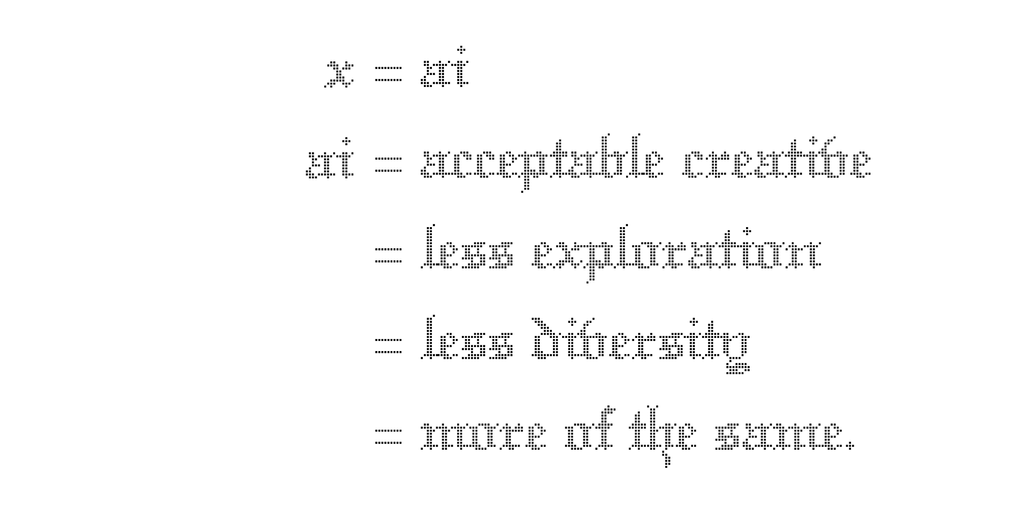
AI doesn’t have to produce mediocre work to make the industry more mediocre. It only has to make the average answer easier to reach. A market of ‘good’ means true creativity will stand out as excellent.
Distribution vs. Impact
Mathematics gives you the average, but it also gives you the distribution.
Two sets of creative ideas could have exactly the same average quality while being radically different in terms of range.
The question isn’t whether AI can produce a good answer. Of course it can. The question is what happens to the range of answers when everyone starts asking the same questions to find them.
AI has a place in any business, in any creative agency. However, we should be aware of optimising creative production around AI which naturally encourages convergence. Baxi’s argument that the “middle” gets wider as the range of outputs shrink is a reminder that without creative trial and error, you risk the loss of breakthrough.
Leave the final decision to the ‘mathematicians’
I was told that I needed to learn these basic mathematical skills because ‘no-one is carrying a calculator inside of their pocket.’ The joke’s on whoever told us that.
Creative industry leader Andrew Shea hit the nail directly on its head: ‘Work that pass[es] through a human understanding of how design makes a person feel… will keep its edge”. Through education, experience and intuition, designers and creatives alike have honed the craft of communicating.
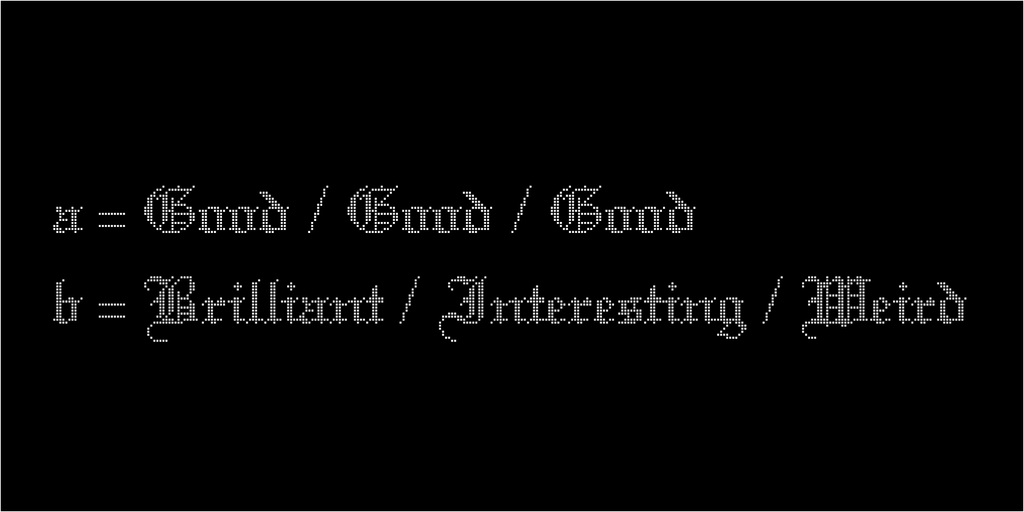
Creative value lies in the following: knowing what to make, what not to make, when an idea needs to be pushed further, when something feels right, and most importantly, having the confidence to reject an obvious or ‘average’ answer.
In other words, as production becomes more abundant because of AI, judgement and creative instinct will take a front seat. A creative agency’s premium will change from technically correct execution, to judgement, sharper decision making, and knowing what people need.
How far can we get from average?
This maths lesson isn’t about how easy it is to find the average. After all, the average is only useful when you know what you’re trying to understand. The job of the creative isn’t simply to find an answer, but to explore your motivations, your audience, your goals, your WHY.
AI can find the mean, the median, the mode, it can generate thousands of different possibilities. Creativity is about the complex questions and recognising the answer that nobody else would have found.
In the age of AI, the question to be asking isn’t “how quickly can we get to good?” but rather, “how far can we get from average”? Creativity is about exceeding, elevating, and exploring the uncharted. When everyone has access to the same external resources and tools, the competitive edge won’t belong to people who have found a speedy solution. It belongs to the people who know what is worth making.
“Creativity is about the complex questions and recognising the answer that nobody else would have found.”
Are your creative answers starting to look a little average? Get in touch with us at Big Orange. We’ve got the tools, tips, and strategies to help you find your next breakthrough.